
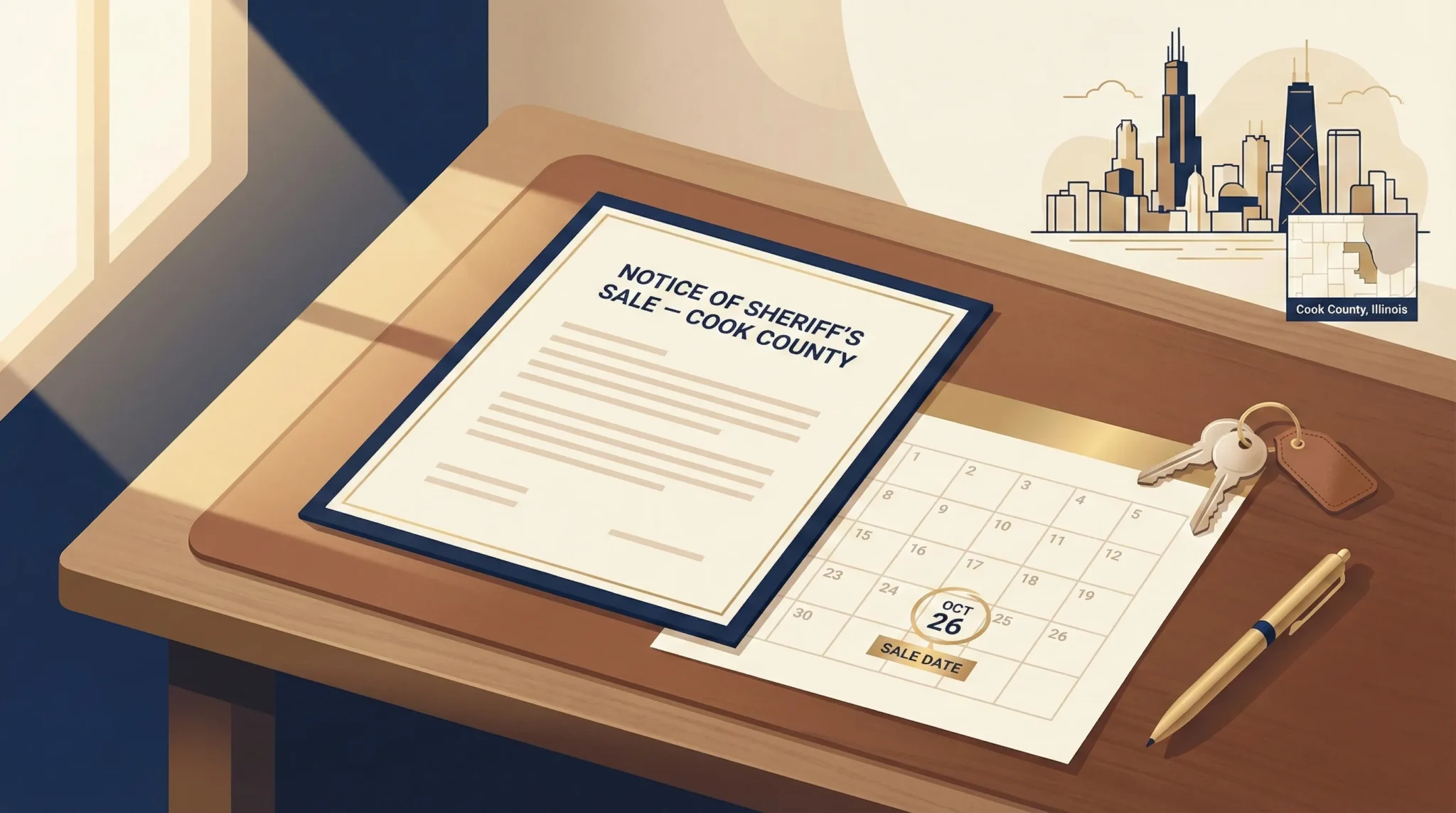
By the time a Cook County foreclosure reaches a sheriff’s sale, most homeowners are exhausted. You have lived with months of letters and court dates. You have heard different stories from friends, the internet, and even people in the courthouse. The sale date finally appears on a notice, and your brain jumps to the worst conclusion: that you will be out the same day strangers bid on your home.
That is not how Illinois foreclosure law actually works.
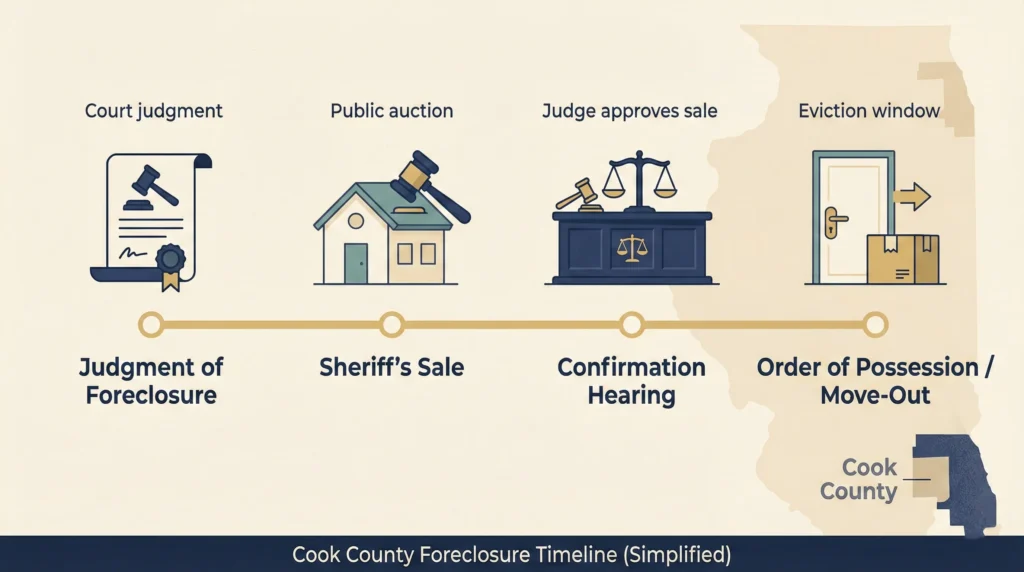
A sheriff’s sale is a public auction of the property after the court has entered a judgment of foreclosure. It is serious and emotional, but it is also part of a structured process. There is usually a gap between the auction and the day the court confirms the sale. There is another gap between confirmation and the day the sheriff can legally remove you. Those weeks matter if you are trying to plan a move, protect your family, or explore any last options.
This guide focuses on what happens around the sheriff’s sale in Cook County. We will talk about how sale dates are set, what really happens on auction day, what a confirmation hearing is, when an order of possession comes into play, and how The Bow Tie Attorney can sometimes adjust timing or outcomes during this phase.
If you already have a sheriff’s sale date or a recent sale notice, The Bow Tie Attorney can review your orders and give you a realistic timeline so you know what is coming and when.
A sheriff’s sale is the court ordered auction of a foreclosed property. In Cook County, these sales are typically conducted by or through the Sheriff’s Office after the court enters a judgment of foreclosure and an order approving sale terms. The property is offered for bid, and either the lender or a third party purchaser becomes the successful bidder.
The sheriff’s sale is about who will own the property next. It is not, by itself, the legal moment when you have to leave.
By the time the sale is scheduled, several things have usually happened. The court has entered a judgment of foreclosure that sets the amount owed and cuts off most defenses. Any statutory redemption period has either expired or will expire by the time of sale. The lender has obtained an order allowing the property to be sold at public auction and has complied with notice and publication requirements. You may still be living in the home at this stage, and for most families that is exactly what happens. Understanding that you are still the legal occupant until the court says otherwise is the first step toward planning instead of panicking.
After judgment, the lender or its attorney asks the court to approve the terms of sale and set a sale window. Once that order is entered, the selling officer schedules a specific date and time. Under Illinois law, there must be advance notice and publication before the auction, and homeowners typically receive mailed notice telling them when and where the sale will occur. In Cook County, sale information is also listed through the Sheriff’s Office or designated auction platform.
In real files, the timing between judgment and sale can vary. Sometimes months pass before a sale is set, especially if there are loss mitigation discussions or court delays. In other cases, the lender moves quickly once redemption has expired. The key is that a sale date is not a surprise out of nowhere. If you are watching your case and your mail, you will see the order of sale and the notice of sale before the auction happens.
On the day of the sheriff’s sale, the auction itself is usually much less dramatic than homeowners imagine.
The selling officer announces or posts basic information about the property, the opening bid, and the terms. Bidders submit offers, often in a matter of minutes. In many Cook County cases, the lender itself is the highest bidder, using a credit bid based on the judgment amount. In others, an investor or third party purchases the property. When the auction ends, the officer prepares a report of sale and issues a certificate or memorandum of sale to the successful bidder.
Here is what does not usually happen that day: the sheriff does not come to your door to remove you immediately after the auction. The sale still has to go back to the judge for a confirmation hearing. Until the court confirms the sale and deals with possession, you remain in the home as a lawful occupant under the foreclosure case, even if ownership will soon change.
After the auction, the party that conducted the sale files a report with the court. The lender or purchaser then asks the judge to confirm the sale at a separate hearing. Under the Illinois Mortgage Foreclosure Law, the court must review the sale and decide whether it was properly conducted, whether the terms were followed, and whether the price is unconscionably low or justice was otherwise not done.
Practically, this confirmation hearing often takes place several weeks after the sale. At that hearing, the judge will decide whether to approve the sale. If the court signs an order confirming the sale, that order usually also addresses whether there will be any deficiency judgment and whether an order of possession will issue in favor of the purchaser. Only then does the case move into the true post sale phase where possession is at stake.
The weeks between auction and confirmation are often the last window to raise issues, negotiate timing, or plan a controlled exit. The Bow Tie Attorney helps you use that window intentionally instead of letting it slide by.
For most families, the most important question is simple: when do we actually have to leave. The answer in Cook County usually depends on two things. First, when the court enters an order of possession in favor of the purchaser. Second, how long that order is stayed before the sheriff can enforce it.
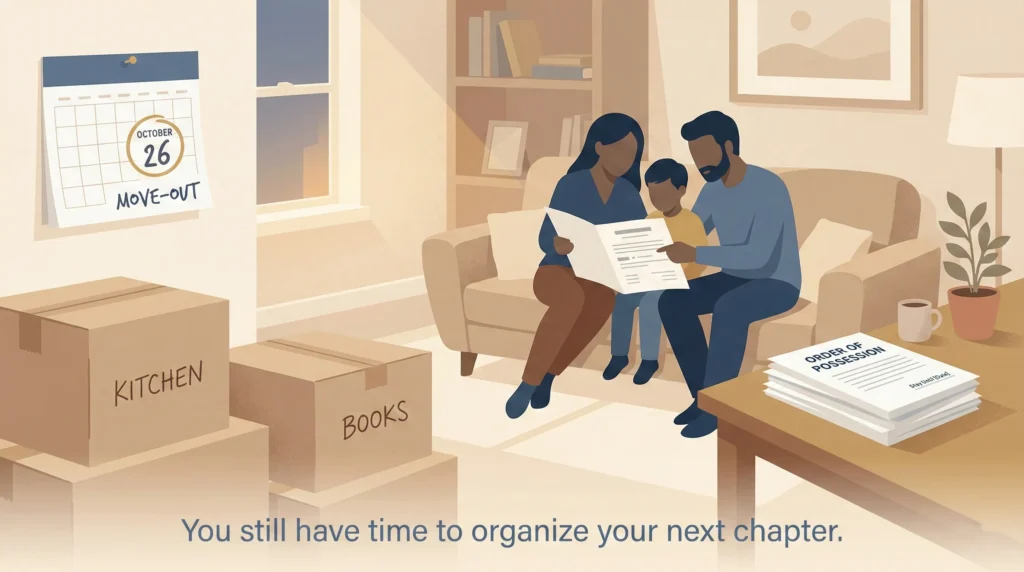
In many confirmation orders, the judge will grant possession to the new owner but stay enforcement of that order for a set period, often around 30 days, sometimes longer or shorter depending on the case and any agreements in place. During that stay, you are expected to prepare to move, but the sheriff is not yet coming to change the locks. Once the stay expires, the purchaser can deliver the order to the sheriff to schedule a physical eviction. Because the Sheriff’s Office has its own workload and scheduling limits, there is usually additional time between the end of the stay and the actual lockout date.
In practice, that means most homeowners have weeks, and often a month or more, after confirmation before they must be out. It is not wise to push the limits of that timeline, but it is equally harmful to assume that the sale itself means you must leave that night. Understanding the sequence gives you space to arrange housing, plan moves, and avoid rushed decisions that make a hard situation worse.
By the time a sheriff’s sale is on the calendar, many homeowners feel like it is too late to call a lawyer. In reality, there is still meaningful work to do. Mahmoud can review the orders in your case, confirm the actual sale and confirmation dates, and explain your likely possession timeline in plain English. In some files, there may be grounds to object to confirmation, challenge aspects of the sale, or negotiate different move out terms.
Even when the sale and confirmation will stand, counsel can sometimes help you secure more time, coordinate a voluntary move out with the purchaser, or address related issues such as deficiency risk and how the foreclosure will interact with your broader financial picture. The goal is not to pretend the sale did not happen. The goal is to land as safely as possible in the time that is left.
If you are approaching or have already passed a sheriff’s sale in Cook County, you do not have to navigate the last part of the process alone. A focused strategy session with The Bow Tie Attorney can give you clarity on timing, options, and concrete next steps.
In most Cook County foreclosure cases, no. The sheriff’s sale is the auction where the property is sold, but the sale still has to be reported back to the court and confirmed at a later hearing. Only after the judge signs an order confirming the sale and granting possession, and any stay on that order has expired, can the sheriff be called to physically remove you. That process usually takes weeks, not hours, although exact timing depends on your specific case and the Sheriff’s Office schedule.
Illinois law requires advance notice and publication before a sheriff’s sale. In practical terms, homeowners usually see an order of sale entered in their court case and receive a written notice of sale by mail that lists the date, time, and location of the auction. Sale information is also posted through the Sheriff’s Office or the selling officer’s website. If you are in foreclosure, it is important to keep your mailing address updated with the court and to check the online docket regularly so sale dates do not come as a surprise.
Yes, sheriff’s sales are frequently continued, postponed, or canceled. Common reasons include active loss mitigation or loan modification reviews, bankruptcy filings, court ordered stays, last minute reinstatements or redemptions, or agreements to pursue alternatives such as short sales or deeds in lieu. Sometimes the lender simply continues the sale for its own internal reasons. If you see a sale date on the books, it is important to verify shortly before the auction whether it is still going forward.
At the confirmation hearing, the judge reviews the report of sale to ensure that the auction was conducted according to the court’s order and the law. The court looks at whether proper notice was given, whether the terms of sale were followed, whether the price is unconscionably low, and whether there is any reason that justice would not be done by approving the sale. If the court confirms the sale, it will usually also address any deficiency judgment and enter or schedule an order of possession in favor of the purchaser.
It depends on the language of your orders and the Sheriff’s Office schedule. Many confirmation orders in Cook County grant possession to the purchaser but stay enforcement of that order for a period such as 30 days. During that stay, you can remain in the property while preparing to move. After the stay expires, the purchaser can submit the order to the sheriff to schedule an eviction. Actual lockout dates often add additional time, because the sheriff must coordinate staffing and other scheduled evictions.
Often yes. Even when a sale date is on the calendar, there may be options to explore. An attorney can check the court file and sale notice for errors, evaluate whether there are grounds to object to confirmation, help you understand your true move out timeline, and negotiate with the lender or purchaser regarding possession and, in some cases, cash for keys style arrangements. At a minimum, you gain clarity about what is coming so you can make informed decisions for your family.

Stay ahead of industry changes with our comprehensive continuing education program. New courses added monthly, covering everything from legal updates to market trends.
Connect with like-minded professionals who share your commitment to excellence. Build relationships that last beyond any single transaction or market cycle.
Position yourself as the go-to expert in your market. Our advanced certifications and specializations help you stand out in an increasingly competitive landscape.
“Excellence is not a skill, it’s an attitude. In real estate, that attitude translates to meticulous preparation, unwavering ethics, and an uncompromising commitment to client success.”
— Mahmoud Faisal Elkhatib, The Bow Tie Attorney