

What is a “zombie” second mortgage?
If a second lien resurfaces, it doesn’t automatically mean you owe what’s
claimed—or that the claimant can legally foreclose. Some are time-barred, defective, or
unsupported by the chain of assignments and payment history. The CFPB has warned
against suing or threatening suit on time-barred mortgage debts.
Sharp in law. Connected in your deal.
Zombie Second mortgage —structured fast, documented right, and closed with clean title
Why are zombie seconds reappearing?
- Old piggyback structures: Many 2000s purchases used an 80% first lien + 20%
second lien. Years later, these seconds are being pursued by debt buyers or
revived by servicers. - Data/servicing migrations: Transfers can surface dormant accounts, sometimes
with incomplete records. - Market incentives: As values rise, junior lienholders see more equity to
target—especially in Chicago neighborhoods that have recovered. - Enforcement pushback: Federal guidance increased scrutiny of illegal collection
on time-barred seconds, but activity persists—so owners must respond
intelligently.
Cook County basics: Where does this play out?
The legal framework (Illinois + federal)
Zombie-second disputes and foreclosures run through the Circuit Court of Cook
County, Chancery Division (Mortgage Foreclosure Section). The court also offers a
Mortgage Foreclosure Mediation Program connecting homeowners to housing
counselors and legal help early in the case. Mediation doesn’t erase deadlines, but it
can coordinate documents and keep negotiations on track.
1. Statute of limitations for written notes (Illinois):
2. Reinstatement & redemption (Illinois Mortgage Foreclosure Law):
- Reinstatement: You may cure defaults and reinstate within 90 days after service
of the foreclosure summons. - Redemption: For residential property, the redemption period ends on the later
of 7 months after service or 3 months after the foreclosure judgment (with
special variations for abandonment or deficiency waivers).
3. Federal guardrails (CFPB):
Collectors who sue or threaten suit on time-barred “zombie” mortgages risk violating
the FDCPA and Regulation F. The CFPB has explicitly addressed zombie seconds.
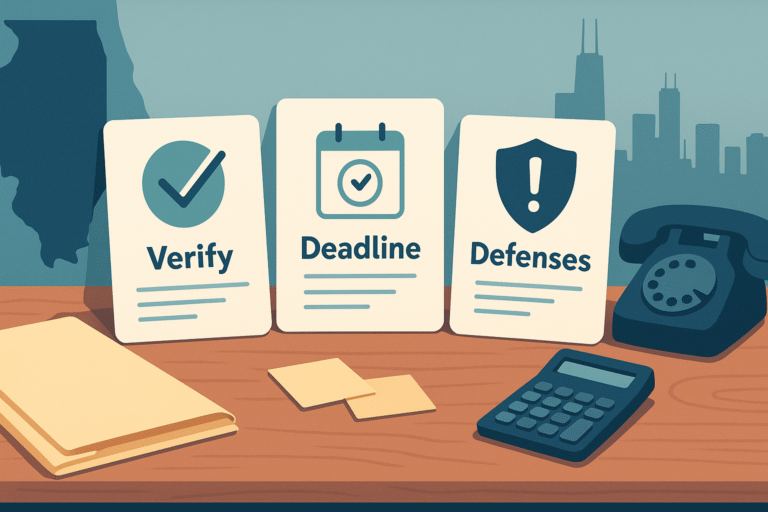
First 48 hours: the Owner’s Validation Checklist
- Don’t ignore it. If you’re served, your clock starts. Put all deadlines on a
calendar. - Pull your documents: note, second mortgage, HUD-1/CD, any modification,
prior communications, payment history. - Order a title search or O&E report: confirm the second lien’s recording,
assignments, and releases. - Date math: identify the last payment, acceleration letter, any written
acknowledgments. Compare to the 10-year limitations rule. - Demand validation: if contacted by a collector, request full validation and the
account records; preserve all envelopes and letters. - Evaluate options: mediation intake (Cook County), negotiation (settlement/short
payoff), litigation defense, or sale/refi to clear both liens—depending on equity
and timelines.
If a foreclosure has been filed, add: appearance & answer deadlines, reinstatement
(90 days), and redemption windows to your case plan.
Defenses & pressure points (case-by-case)
- Time-barred claims: If the limitations period ran without a tolling/restart event,
suit or threats of suit can be illegal. - Standing & assignments: Demand proof of ownership of the note and lien;
scrutinize allonges and recorded assignments. - Accounting gaps: Missing payment histories, chargeoffs, and transfer dates can
undermine the claim. - Amount calculation: Interest rate, fees, and advances must match the contract
and Illinois law. - Procedural leverage: Scheduling, discovery, mediation, and motion practice in
Chancery can create room for settlement or dismissal where records are weak.
FAQs
Is a zombie second always collectible?
No. Some are time-barred or
unsupported by records. You must verify dates and documents.
Will mediation stop everything?
Can a small payment restart the clock?
Where do Cook County foreclosure cases live?
Sharp in law. Connected in your deal.
Zombie Second mortgage —structured fast, documented right, and closed with clean title
Sources
● CFPB advisory/blog on time-barred “zombie” second mortgages and FDCPA
implications.
● Illinois 10-year statute of limitations for written contracts/notes (735 ILCS
5/13-206).
● IMFL reinstatement (90 days after service) & redemption windows (residential 7 months from service or 3 months from judgment).
● Circuit Court of Cook County—Chancery Division (Mortgage Foreclosure Section) and Mediation Program info.