

Story note: The story below is fictional and created for education. It is not a real client story and it does not describe any specific person.
Marisol finds a condo she loves. Great light, great location, solid building. She is already picturing furniture in the living room.
Then the resale packet comes in. Buried in the documents is a planned project and a number that changes the math. A special assessment that would add thousands in the first year. Suddenly the question is not “Do I want this condo” but “Can I carry this risk.”
This post is a guide to spotting special assessments early, before they control your timeline.
Important: This article is general information, not legal advice for your specific facts.
If you are under contract, the best time to review the condo documents is now, not three days before closing. We help buyers and investors pressure test the building’s finances, planned projects, and risk signals, so decisions are made with real information.
Important: General information only, not legal advice.
A special assessment is an extra charge on top of the regular monthly assessments. It is usually tied to a big expense the association needs to cover, like roof work, masonry and facade repairs, elevators, plumbing, or major code compliance. Sometimes it is a true emergency. Sometimes it is simply a reserve problem that finally caught up to the building.
Illinois law expects associations to plan for capital expenditures and deferred maintenance through budgets and reasonable reserves, and it even describes factors boards should consider when setting reserves, including repair costs, useful life, professional reserve studies, and the financial impact on owners. See 765 ILCS 605 Section 9.
Chicago reality: Even a “good building” can have a large assessment. What matters is whether it was predictable and whether the association communicates it clearly.
Here is the mindset shift that saves money. You are not only buying a unit. You are buying into a shared financial system. That system is the association’s budget, reserves, and decisions.
If you only read the listing and the condo rules, you will miss the real story. The early warnings are usually in documents buyers skim.
Also note the operational piece. Section 22.1 states the designated officer should furnish the information within 10 business days of a written request, and it allows a fee with a stated cap, plus a rush fee option. That means you should request the packet early, because waiting can compress your timeline fast. See 765 ILCS 605 Section 22.1.
Chicago has some building realities that can drive large association projects. Weather and age matter, but local compliance can matter too.
One common driver in high rise buildings is exterior envelope work. Chicago’s building code includes requirements around written condition assessment reports for exterior walls of high rise buildings, including exterior walls, balconies, fire escapes, and related components. That kind of work is expensive, and it often becomes an assessment when reserves are not ready.
Reference section: Chicago Building Code 14A 6 603.2.
These are the patterns that cause “How did no one tell me” moments:
Marisol’s first instinct is to panic. Esme, her broker, slows it down and asks three questions.
Negotiation paths that are common in Chicago condo deals:
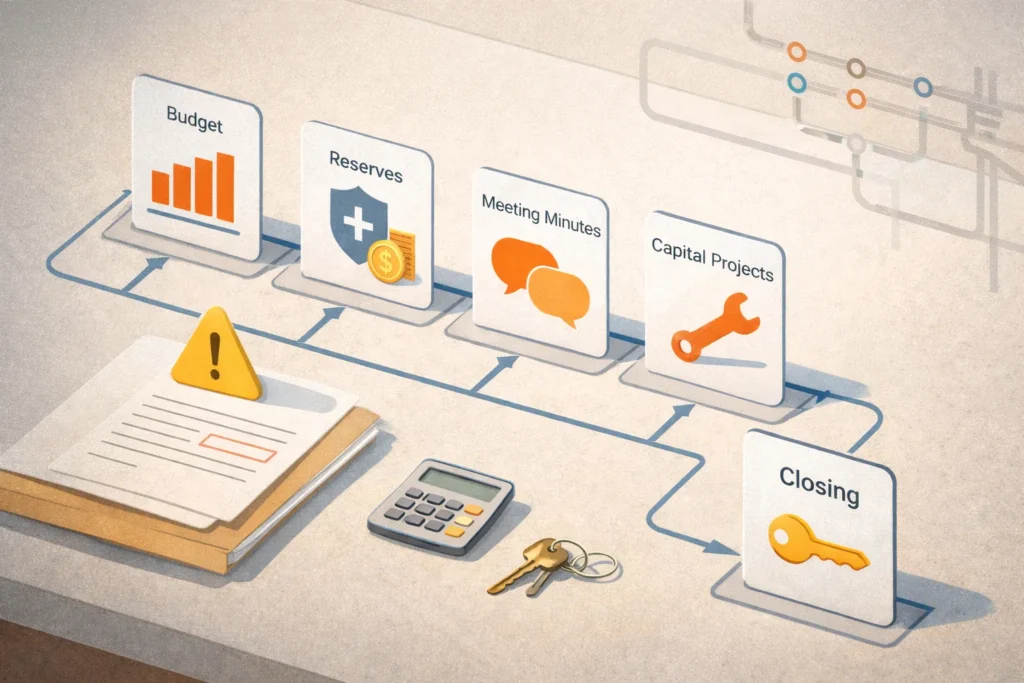
The fastest way to reduce anxiety is to turn the building into a readable file. Budgets, reserves, minutes, planned projects, and a clear answer on whether an assessment is approved.
If you want one simple system, use this. It keeps you out of the most common traps.

Use official sources for the baseline rules, then apply them to your building’s documents.
Compliance note: This article is general information as of the date you publish it. It is not legal advice. Rules, procedures, and building specific requirements can change.
If you want clarity, bring the 22.1 packet, the budget, minutes, and any assessment notices. Most decisions get easier when the paperwork is organized and complete.
Not always. Sometimes it means the building is addressing real needs responsibly. The key is whether the project is planned, communicated, and supported by a clear financial strategy.
Section 22.1 calls for a statement of anticipated capital expenditures within the current or next two fiscal years, plus reserve fund status. See 765 ILCS 605 Section 22.1.
Section 22.1 states the designated officer should furnish the information within 10 business days after a written request, and it allows fees within stated limits. Request it early so your timeline does not get squeezed. See 765 ILCS 605 Section 22.1.
Illinois law treats unpaid common expense amounts as a lien on the unit owner’s interest, with details and priorities described in the statute. See 765 ILCS 605 Section 9.
Start with facts: approved or not, amount, and payment structure. Then match it to a clean option: seller credit, price adjustment, payoff at closing, escrow, or exit. The right move depends on your contract timeline and the building’s documentation.
Ask if any special assessment is approved or planned, what projects are anticipated in the next two fiscal years, what reserves exist for those projects, and whether there are pending lawsuits or insurance issues. Many of these items are referenced in the Section 22.1 disclosures. See 765 ILCS 605 Section 22.1.

Stay ahead of industry changes with our comprehensive continuing education program. New courses added monthly, covering everything from legal updates to market trends.
Connect with like-minded professionals who share your commitment to excellence. Build relationships that last beyond any single transaction or market cycle.
Position yourself as the go-to expert in your market. Our advanced certifications and specializations help you stand out in an increasingly competitive landscape.
“Excellence is not a skill, it’s an attitude. In real estate, that attitude translates to meticulous preparation, unwavering ethics, and an uncompromising commitment to client success.”
— Mahmoud Faisal Elkhatib, The Bow Tie Attorney